



Picture cruising through city streets or powering up a hill without hardly breaking a sweat—not with the simple push of a lever or flick of your wrist. That—the promise to help make teetering, sluggish riders a distant memory—is the thrilling freedom of an e-bike with a throttle. For many markets where e-bike regulations are less stringent, the throttle is not just a feature, it’s an opening to enjoy cycling more than ever. It turns your electric bicycle into an even more useful e-vehicle; it frees you from the effort of pedaling while still providing on-demand all-wheel power exactly when you need it! Learning what a throttle is, how to use it, and what to look for is the first step in unleashing this awesomeness.
1. What is an E-bike Throttle?
At the most fundamental level, an e-bike throttle is a control on the handlebar that enables you to use your motor and go faster without pedaling. It works similarly to the accelerator of a scooter or motorcycle. You engage the throttle, a signal is sent to the bike’s controller, and power from the battery then comes out to move the motor. This gives immediate acceleration and allows the bike to be ridden on motor power alone.
The two most common throttles you will find are:
Twist Throttle:
It is a part of the handlebar grip. You rotate it toward yourself to speed up. Some grips are “half-twist,” meaning that they only cover the inside half of the grip, which allows you to also get a firm hold on the handlebars. Other grips are “full-twist,” with the grip rotating completely.
Thumb Throttle:
This is a tiny lever that you push with your thumb to activate the motor. It’s not built into the grip, which a lot of riders like because it prevents accidental acceleration—and getting sore wrists on long rides.
The primary difference between a throttle and a Pedal Assist System (PAS) is the input. With PAS, the power level (often 1-3) relates to a “Cycling Mode”. As you pedal, sensors detect your movement, and the motor provides a corresponding level of assistance and output efficiency. By contrast, a throttle gives you power when you want it, whether your feet are moving or not.
2. How to Choose the Best Throttle E-bike
If you are in the market for an electric bike with a strong and dependable throttle, there are several important things that will contribute to the quality of your ride. Thinking in these terms can guarantee you a bike that’s fun, as well as safe and reliable.
Responsive Motor and High Torque:
A throttle is only as responsive as the motor behind it. Opt for a bike with a high-torque motor. Measured in Newton-meters (Nm), torque is the rotational force that gets you going from a stop and also helps you climb hills. More torque means more force at play when you open up the throttle.
Battery Capacity:
A big battery is necessary to get you a decent range. The unit of battery capacity is the ampere-hour (denoted Ah) and watt-hour (Wh). The higher the number, the more fuel you have in the tank for lengthier, throttle-empowered adventures.
Strong Brakes:
Great power simply is not any fun when a vehicle takes its time coming to a stop. If a throttle can whip you into traffic fast, then brake systems must have the strength to enable high speeds and bring you safely home. Mechanical disc brakes are a solid base level, whereas hydraulic disc brakes give better stopping power and more modulation, which can be very useful for performance throttle riding.
Solid Frame and Construction:
The frame of the bike should be robust enough to withstand the stress of motorized acceleration. Seek out frames constructed from quality aluminum alloy, which provides a good combination of strength and weight. Throttle usage is particularly convenient for fat tire e-bikes with their wide tires and subsequent great balance and traction on virtually all terrain.
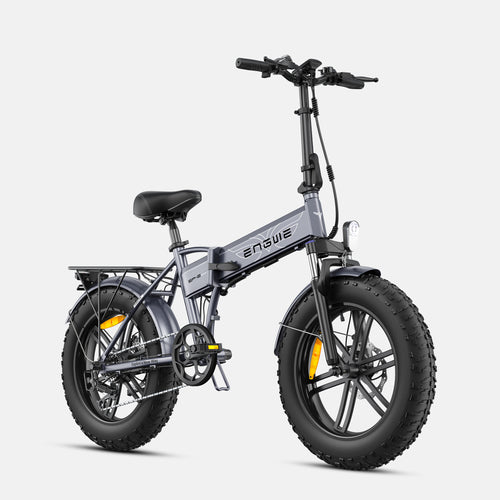
And when it comes to finding a brand that combines all of these features harmoniously, one name always sits at the top for riders seeking exceptional performance and unparalleled versatility: ENGWE. The ENGWE EP-2 Boost is an ideal example of a throttle e-bike made for adventure. It’s powered by a 250W high-torque brushless motor, and its special Boost Mode kicks in with an astounding 55Nm of torque to eliminate steep hills or for quick laps around the block—all at the press of the throttle. It is powered by a 48V 13Ah high-capacity battery which ensures an extensive ride ranging from a minimum of 120 km on full throttle to the maximum level of PAS. Its massive 20x4.0 all-terrain fat tires and a tough one-piece frame are built for anything you want to ride on, from pavement to sandy trails. Safety comes first with powerful 180mm mechanical disc brakes that can handle even the most extreme weather conditions. If that's not enough, you also have an outstanding torque sensor for super quiet and smooth power delivery and an easy folding mechanism for transportation or storage with a robust 150kg payload capacity; truly the perfect gateway to fun or utility!

3. Is a Throttle-Controlled Electric Bike Legal to Ride?
Legality is the key pressing matter. You have more freedom in less regulated markets, but you still need to know the rules of the game. Internationally, e-bikes tend to fall into classes:
Class 1:
Only pedal-assist, with a motor that stops assisting at 20 mph.
Class 2:
Throttle-equipped with a motor that ceases assistance at 20 mph.
Class 3:
Pedal-assist only, with a motor that ceases to assist at 28 mph.
For users in unrestricted territories, you can often buy and ride bikes that surpass such classifications. But “unrestricted” does not mean lawless. Local laws may still apply on whether to use a helmet, how old you need to be, or where you can ride. Battery-assisted e-bikes with throttles could be banned on some multi-use bike paths or nature trails, so it’s always best to check local rules before you ride. Just because we can be lenient on throttle use doesn't mean we should be.
Unlocking Speed Limits: How to Get More From Your E-bike
Many producers equip their e-bikes with a software speed limit to comply with different international laws. And because in many markets they don’t have to, riders are constantly looking for methods that will allow their bike to deliver its true potential. This is in most cases easily done through software adjustments.
| Feature | Throttle | Pedal Assist System (PAS) |
|---|---|---|
| Power Delivery | Immediate or on-demand movement. | Proportional to your pedaling power. |
| Effort Required | None. You do not need to pedal. | You have to be pedaling. |
| Battery Usage | High. Drains the battery much faster. | Moderate to low. Extends battery range. |
| Control | Accurate speed control for acceleration. | Cadence or torque-based. |
| Best use | Traffic light getaways, hill boosts. | Exercise, long-distance touring. |
Software Methods for Unlocking Speed
Now, before we begin the disclaimer, keep in mind that if you try this on your bike it could void your warranty, and make sure you are safe when riding. On platforms such as YouTube, a lot of unlock tutorials can be found by searching for your specific bike model.
For most bikes, such as some ENGWE models, it is carried out via the settings menu on the display unit.
New Method of Engwe Speed Limiter Hack:
- Power On: Press any key to power on the e-bike display.
- Enter the settings: Press and hold the up and down buttons on your control pad at the same time.
- Go to Speed Limit: Enter the "Setup" menu and then move down until you find and click the "Speed Limit" option.
- Up the Limit: Adjust the speed limit value to its maximum setting by pushing the up and down buttons.
- Set and Exit Carefully: Press the "Set" button to confirm. Then press "Back" once to get out of the speed limit setting, then again to go back all the way to the primary home screen. Do not turn off the bike while in this exit sequence.
Other e-bikes that have a companion app have a different, but just as simple, process. It typically requires connecting your phone and your bike via Bluetooth, then making a setting switch in the app. You would usually download the app, make an account, connect to your bike, and go under a setting possibly titled “Class 2” or some equivalent. From there, you can pick an “Unlock” or “Class 3” option, which raises the maximum speed.
Holding a handlebar is not an end in itself; it is the beginning of a new journey—and your key to freedom.
Frequently Asked Questions
1. Is it bad for my e-bike if I use the throttle constantly?
No, good quality e-bikes are built for constant throttle use. But it will wear out parts like the motor and tires more quickly, and perhaps most importantly, it will have a big negative impact on how far your battery can take you.
2. Can I install a throttle on my pedal-assist-only e-bike?
Yes, often a throttle kit can be installed. That likely means swapping out the controller and display and splicing in the new throttle. It is difficult and most suitable for electronics enthusiasts and professionals. Incorrect installation may cause damage to your e-bike.
3. How significantly will my range be affected by using the throttle vs. pedal assist?
The difference is significant. If you are only using the throttle, your maximum range can be 30% to 50%—or more—less than if you were using a low level of pedal assist. The figure varies based on terrain, rider’s weight, and cruise speed.
4. Is it harder to control an e-bike with a throttle than a bike without one?
There’s a slight learning curve. The immediate power can also be a little shocking to new riders, so you should begin in an open space and build your speed carefully. However, most riders acclimate to it very fast and feel the on-the-fly power is easy to control for quick maneuvers.
5. If I modify my bike and get caught, does it void my warranty?
In almost all cases, yes. This is invariably a direct breach of the manufacturer's warranty terms, as you are 'modifying' factory settings to begin with—yes, including modifying the speed limiter. Always refer to your warranty documentation before implementing any changes.


